I imagine I have many readers who mourned when I took down the blog posts on my website around a year back. The astute ones probably determined that the posts were all still publicly available on my GitHub, but nevertheless no new content had been added for the past year. Sarcasm aside (I have no readers…), you may be wondering why I’ve obfuscated my blog from the public. This file is password-protected – if you are reading this, I’ve either given you the password because I know you or you had too much time on your hands and followed the hints on my website to retrieve the password. If you fall in the latter category, shoot me an email at avyukd@gmail.com and I’ll Venmo you like 5 bucks or something (more or less, depending on how many emails I get), partly because you deserve a reward for your hacking and partly because I want to know who’s reading what I write (this must be the first ever blog that readers get paid to read!).
Anyways – why am I doing this? Why not just write publicly on my website or anonymously on Substack like a normal person? I want to write things and I want to keep a record of these written things. I don’t really care if people read what I write, but it would be cool if some do. I don’t want things that I say to be taken too seriously (and thus don’t want to completely expose them to the public), but I would like my readers, if any, to know that I wrote them.
I don’t know of any blog hosting site that meets the above criteria. I considered just journaling – why post links on my website when I don’t really care about readership? First, posting things in a public forum enforces some sense of accountability, second, it’s more satisfying to do (hitting the publish button vs. just saving and closing a word doc – boring!), and third, it’s an unnecessary compromise – I don’t care about readership, but I’d prefer to leave the option open.
A more fundamental question – why write? Since early high school through college, I’ve had teachers and professors tell me my writing is great (relative to other students which isn’t saying much, but still) – I think I even landed a job based partly on the strength of my writing! By continuing to write, I ensure my writing doesn’t get significantly worse over time. I don’t really expect it to improve, but 20 years from now, I don’t want to be among the set of incompetent adult communicators out there that struggle to convey their thoughts. Additionally: (1) writing forces me to “untangle” thoughts that would otherwise remain tangled in my head (Paul Graham wrote about this) and (2) it’s fun!
Enough setup – what is this blog going to be about? Really, it’s just going to be me yapping away about whatever I want – more formally, these are stream of consciousness posts: this blog captures my thoughts as they pass through my mind. A few ground rules: (1) no proof-reading or re-writes – I write what I write and post it. There are going to be mistakes, discontinuities, and contradictions – deal with it (This probably conflicts with the main reason I said I was going to write – because it prevents me from becoming a worse writer. Contradictions are constitutive to my posts, so if it angers you, you should probably stop reading now) (2) don’t take anything I say seriously – I may talk about investing. Nothing I say is financial advice. I may make up sources and say things without citing them (Did Paul Graham really write about “untangling” thoughts? Maybe, but I could totally just be hallucinating that as well.). If you accept things, you read here as truth, you are truly stupid.
Recently I had to decide what I am going to do with the rest of my life: become a software engineer or work as an investment analyst. For context, I interned as a software engineer at a quantitative finance company over the summer (no return offer) and as an investment analyst at a hedge fund last winter (return offer possibility). I asked a lot of people how I should decide.
Some of them responded: you should go to the place where you received a return offer. The job market is tough and having a return offer is an opportunity you must seize (I didn’t technically receive a return offer; I had the possibility of receiving a return offer – the details are kind of weird. But for the rest of this conversation, let’s assume I did have a return offer in hand because I’m a beast and would’ve turned the possibility into reality). This line of thinking is short-sighted in my opinion – I was stubborn that I should first choose the career path I prefer and then get a job in that field, rather than immediately resort to desperation, and accept whatever offer I had in hand.
So which line of work do I prefer – software engineering or investing? I enjoy both, maybe investing slightly more. But the work-life balance in software engineering is significantly better, and I’ve been a heavy programming enthusiast since early middle school – I can’t just give that up (sunk cost fallacy…)!
I ended up choosing software engineering, but not for the reasons above. There was something deeper that pushed me towards it that I struggled to communicate until I saw this tweet:
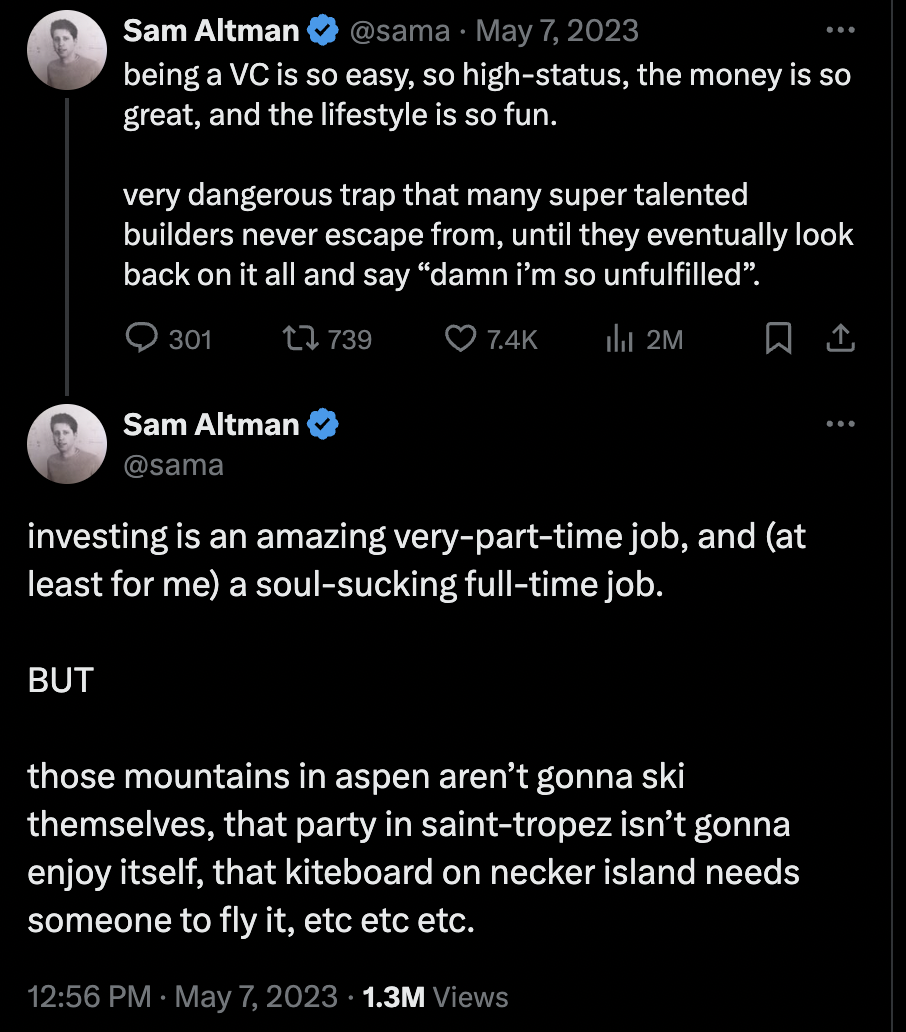
Software engineers build, and investors judge. The engineers (in the generic sense, not just SWEs) add value to society, and the investors judge how much and for how long the engineers can add value. It’s fun to be an investor – you play in a game where you just judge people all the time! I can’t imagine anyone who wouldn’t have fun investing, given they know how to play.
This obviously isn’t 100% true – investors do add some value. All investors help make the market more efficient (we all know this is bullshit, I’m not going to waste my energy on it). Activist investors help unlock shareholder value by improving governance and capital allocation. Short-sellers add value by exposing frauds. VCs add value by giving startup founders critical advice and introducing them to customers. But all this value-add is ancillary to what the builders provide.
A wise man, Samwell Tarly, once said: “I’m tired of reading about the achievements of better men” (I’m doing a GOT rewatch lol). I want to be the better men, the builders.
So how am I going to add value to the world working as a software engineer at a quantitative finance firm? Honestly, I don’t think I will in the sense that I’ve described (great, another contradiction – you must be pissed at this point). Maybe I’ll build some cool trading software but it’s societal value contribution in the utilitarian sense is still nil. However, by becoming a software engineer I will leave the option open for doing something valuable in the future – 10 years down the line I can contribute some value to the world with my acquired software skills or I can devolve to madness like Sam Rogers in Margin Call: I’ll choose the former.
A few things to note: (1) does this all really matter – can’t you pivot between industries once you start? Yes, that option always exists but it’s (1) difficult and (2) unnecessary if I can figure out things earlier (though I presume all adults look back and see that their lives turned out very different from what they may have predicted as a 21-yo). (2) there may have been other subconscious factors at play – at the Berkshire meeting, Charlie Munger (RIP) was asked if we would recommend more young people pursue investing as a career. He responded: “only if you truly have a passion for it – otherwise, we need more doctors and engineers to innovate and power the world forward” (first post so another reminder – I make up quotes). If I have a passion for investing and engineering, I don’t truly have a singular passion for investing, thus I should be an engineer instead. I heard and felt Munger’s statement from other sources as well, and it resonates with me deeply.
I have a lot more to say but it’s late and I have to catch a flight tomorrow morning. This post lacked any real protein (not that you should expect that in a stream of consciousness blogpost), and I’m not sure why anyone would read the above 2-page ramble, but if you feel unsatisfied know that more posts will be out soon.
A quick note about titles: good writers suggest coming up with titles once they finish writing, but I wanted to experiment with something different. In the spirit of having “stream of consciousness” posts, I wanted the title to be a nontrivial phrase/sentence that came to mind when I thought about what my post was going to be about. Though the posts reflect a stream of consciousness, I still have some topics in mind that I expect to write about before I begin writing. Additionally, coming up with a title after writing the post could violate my “no re-writes” rule (though contradictions haven’t stopped me in the past… you get it).
Why “Revenge of the Sith”? I suppose this blog is “evil” in the sense that it represented my true, uncensored thoughts – what I desired to write. It was censored by the Jedi, who are careful to keep their desires in check. The Sith have been suppressed for long enough and are coming back. Writing it all out, the title definitely sucks – I’ll try and have my next title make me sound less “Alex Jones”-esque.